Open Science interview with Martin Fenner is now online
wenn ich zwanzig Minuten brauche um irgendeinen Blog aufzusetzen und da meine ganze Wissenschaft publizieren kann dann ist das schon disruptiv
wenn ich zwanzig Minuten brauche um irgendeinen Blog aufzusetzen und da meine ganze Wissenschaft publizieren kann dann ist das schon disruptiv
Open Data funktioniert dann, wenn es kein künstliches Beiwerk ist, sondern integraler Bestandteil eines Vorhabens Stellungnahme, Bundestag Ausschuss Digitale Agenda von Mathias SchindlerArticle in German
Much like a political democracy, crowd science and managed-innovation processes allow people to have equal input, rather than a single person or party driving the direction of the group without opposition. Anna Gordon. venturebeat.com
Zu wissenschaftlichen Werken gibt es kaum freien Zugang. Jetzt will Berlin den Open Access vorantreiben. Noch aber sind die Initiativen an den Unis zersplittert. Astrid Herbold. Zeit-Online.
As with any right, the right to make a copy is a lot less straightforward than it sounds.
Louis Menand. The New Yorker.
To what extent would [it] be possible to explore innovative cross-subsidies that could provide sustainability (and even profit) to Open Access publications?
Cristobal Cobo's Blog.
Changes that will bring scientific discovery more freely into the public domain are happening. About time too
Science & Technology. The Economist.
The modern research profession is not without its flaws, but even without Richard Feynman it still packs a serious punch
Occam's Corner. The Guardian.
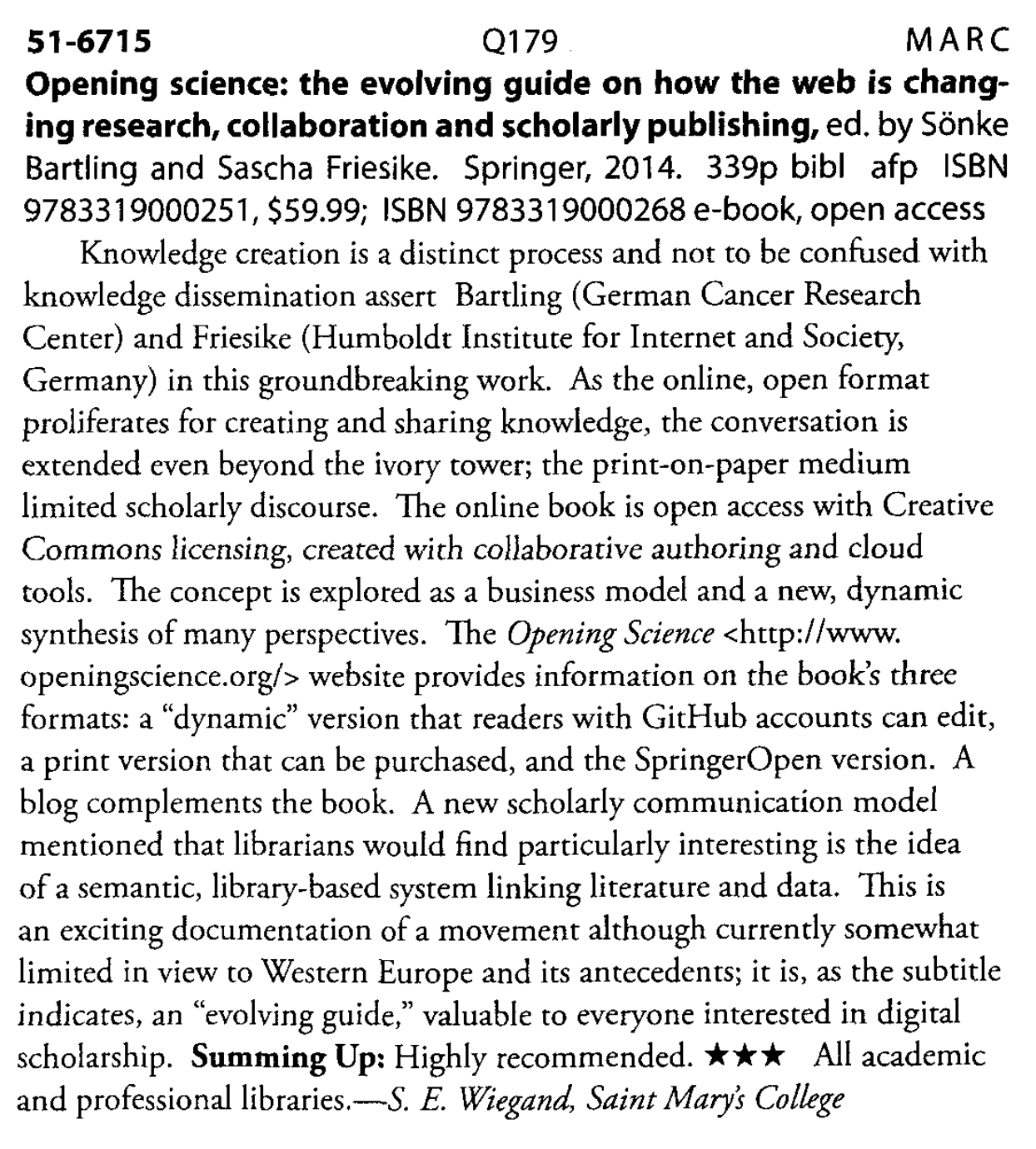
Summing Up: Highly recommended. ★★★ All academic and professional libraries.
In 2013, the federal government spent over $30 billion to support basic scientific research. These funds help create knowledge and stimulate greater productivity and commercial activity, but could we get an even better return on our investment?
TheUpshot. New York Times.
First Monday. Kaja Scheliga, Sascha Friesike.
The director of the Mozilla Science Lab discusses its course on scientific computing together with researchers who have taken the training.
Nature. Toolbox: Q & A.
Paul Royster is proud of what he has achieved with his institutional repository. Currently, it contains 73,000 full-text items, of which more than 60,000 are freely accessible to the world. This, says Royster, makes it the second largest institutional repository in the US, and it receives around 500,000 downloads per month, with around 30% of those going to international users. Unsurprisingly, Royster always assumed that he was in the vanguard of the OA movement, and that fellow OA advocates attached considerable value to the work he was doing. All this changed in 2012, when...Open and Shut?.
Modern science seems to have data coming out of its ears. From genome sequencing machines capable of reading a human’s chromosomal DNA (about 1.5 gigabytes of data) in half an hour to particle accelerators like the Large Hadron Collider at CERN (which generates close to 100 terabytes of data a day), researchers are awash with information. Yet in this age of big data, science has a big problem: it is not doing nearly enough to encourage and enable the sharing, analysis and interpretation of the vast swatches of data that researchers are collecting.
Timo Hannay. Wired.
The open access journal eLife has launched a new type of article that will allow authors to report significant additions to their original research.
TimesHigherEducation.
Just as in the story of the QWERTY keyboard, a system of academic publishing prevailed that works, but is suboptimal. The established system of academic publishing, from submission, review, and publication is in the eye of the socio-technological opportunities outdated. It takes too much time, it is too expensive and leads to an artificial scarcity of content. It no longer reflects the zeitgeist.
This study analyzes rates and ways of data sharing regarding mitochondrial, Y chromosomal and autosomal polymorphisms in a total of 162 papers on human ancient DNA published between 1988 and 2013. [...] Our study highlights three important aspects. First, we provide evidence that researchers motivations are as necessary as stakeholders policies and norms to achieve very high sharing rates. Second, careful analyses of the ways in which data are made available are an important first step to maximize data findability, accessibility, useability and preservation. Third and finally, the case of human ancient DNA studies demonstrates how Open Science can foster scientific advancements, showing that openness and transparency can help build rigorous and reliable scientific practices even in the presence of complex experimental challenges.
Public butterfly count aims to check countryside healthThe charity Butterfly Conservation is calling on the public to help survey the state of Britain's countryside by counting our most colourful insects.
See also: Sir David Attenborough urges public to count butterflies
BBC News.
To create societies where everyone has both access to key information and the ability to use it to understand and shape their lives, we must build knowledge into the heart of all of our activities. This is a big task which requires not just a global shift in mindset, but also that we build the tools and communities to make such a society possible. We invite you to join us from 15-17 July in Berlin for OKFestival 2014 as we consider how to translate Open Minds to Open Action.
Researchers say European commission-funded initiative to simulate human brain suffers from 'substantial failures'
The Guardian.
The UK Working Group on Expanding Access to Published Research Findings, chaired by Dame Janet Finch, report, “Accessibility, sustainability, excellence: how to expand access to research publications,” helped to crystallize a long simmering debate within the open access (OA) community: should the focus for OA advocates be “green” open access – that is, the use of repositories to make research published through traditional subscription-based venues openly available – or should it be ‘gold’ open access – that is, through publication within venues that are themselves open access?